
GraphQL vs REST: Building Smarter APIs
Two Paths, One Goal: Smarter APIs

Introduction
GraphQL and REST APIs are both widely used for fetching data and interacting with the backend servers. Both follow a Client-Server architecture, where the client sends requests to the server, and the server processes the request and sends the required data back to the client.
While they share this fundamental principle, they differ in how data is requested, structured, and transferred, offering different advantages depending on the use case. REST APIs provide a set of fixed endpoints for resources, while GraphQL allows clients to specify exactly what data they need, offering greater flexibility and efficiency.
Before diving into the comparison of GraphQL and REST, let us know about APIs!!
Application Programming Interface(APIs)
Have you ever wondered how a web application works?
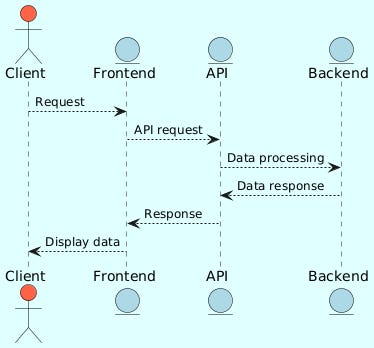
APIs (Application Programming Interfaces) play a crucial role in connecting the frontend and backend of a web application. They are responsible for fetching the required data from the backend and delivering it to the frontend for display, ensuring a seamless user experience.
In modern web applications, the frontend (user interface) and backend (server-side logic and databases) are often hosted separately in different environments. APIs serve as a bridge between them, handling requests from the frontend and sending back the appropriate responses from the backend.
Beyond just connecting frontend and backend, APIs also enable communication between two different backend systems. For example, one server may request data or services from another backend server via an API. This makes APIs essential in microservices architectures and third-party integrations, where multiple backend services need to work together.
Essentially, an API defines a standardized set of rules and protocols that allow different software components to communicate with each other efficiently—whether it’s frontend to backend, or backend to backend.
REST API
REST - REpresentational State Transfer is a type of API which uses HTTP requests and responses to build the communication between two systems over the internet.
They are typically used in client - server architectures.
They request and respond data in JSON format, here is an example,
Request
GET /users/101 HTTP/1.1
Host: api.example.com
Authorization: Bearer your_api_token
Response
HTTP/1.1 200 OK
Content-Type: application/json
JSON content
{
  "id": 101,
  "name": "Alice",
  "email": "alice@example.com"
}
HTTP Methods
REST uses HTTP methods to communicate with the servers, and they use HTTP methods like GET, POST, PUT and DELETE to make operations on the server.
In REST, everything you want to interact with—like user data, files, posts, or images—is treated as a resource that is accessible and manipulable via standard HTTP methods.
A request is sent from the client to the server using a web URL using one of the HTTP methods, then the server responds with the requested response, which could be HTML, XML or JSON(most commonly used.
The HTTP methods used in REST is similar as the CRUD operations, so using this HTTP methods we can perform CRUD operations on the server.
Create => POST.

Read => GET.

Update => PATCH/PUT.

Delete => DELETE.
Stateless
In REST, the server does not store any information from the incoming requests, so all the data required for producing the response should be sent with the request itself.
Each HTTP request is processed independently
This reduces the complexity of the server.
Multiple Endpoints
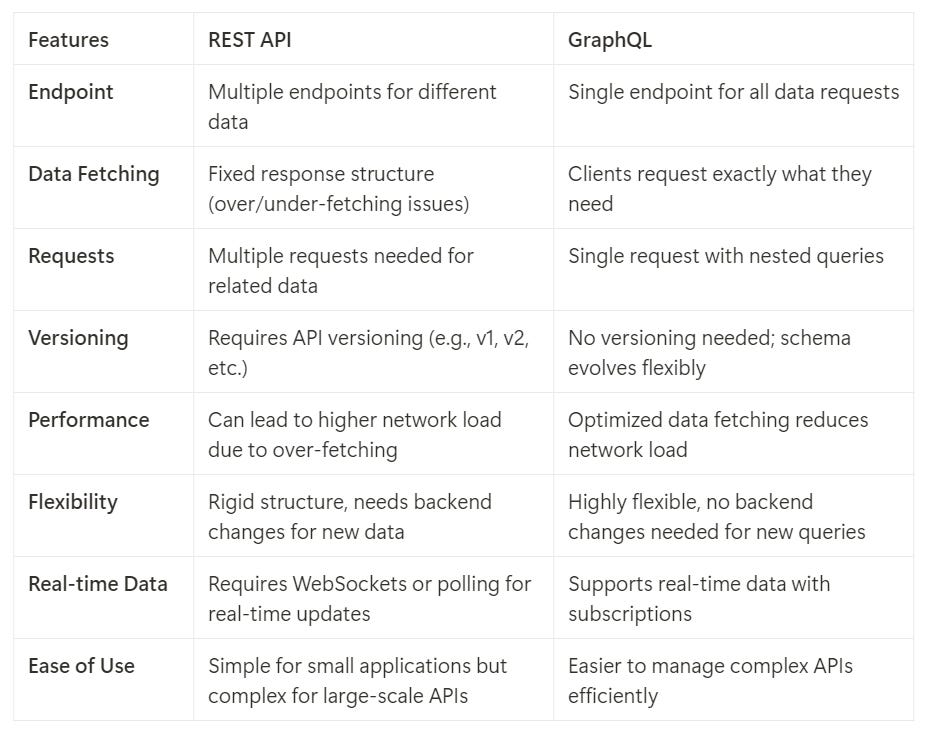
REST has multiple endpoints for each type of data and we need to request different endpoints for different types of data that we need.
So the client needs to send its request to multiple endpoints for different types of data(eg.User ID, Name, address)
Issues
Over-fetching
Suppose you have an API that provides user details. Consider we have to get the user’s name data from the server, instead getting only the name, the REST API fetches all the data of the user like address and mobile number.
In this case, the server sends extra data that is unnecessary for the client.
This increases the traffic across the network increasing the response time from the server.
Time Wastage: Data collection process involves gathering large amounts of data manually, leading to inefficiencies.
Bandwidth Usage: Sending this data consumes a lot of bandwidth, which can slow down communication, especially with limited bandwidth or high latency.
Inefficient Resource Utilization: Processing irrelevant data wastes CPU cycles, memory, and disk space.
Under-fetching and the n+1 request problem
Suppose you have an API that provides user details and user posts, but in separate requests.
The client needs both pieces of information, but since the API doesn’t return them in a single request, it has to make multiple calls.
This leads to under-fetching, where the client receives insufficient data in the initial response and must request additional data separately.
After retrieving the user details, the client now needs to fetch the user's posts. This results in an N+1 request problem, where the client must make N additional requests (one for each user’s posts), leading to performance issues.
This causes a delay in the server's response time.
Tight Coupling of Front and Back Ends
REST APIs face under-fetching and over-fetching issues, which can be managed using controllers on the server.
Controllers are components in the backend—typically part of the MVC (Model-View-Controller) architecture—that handle incoming API requests, execute the necessary logic, and return appropriate responses to the client.
They serve as the middle layer between the frontend and the backend systems, such as services and databases.
In REST APIs, controllers play a key role in managing what data to fetch or return, helping to address issues like under-fetching (where not enough data is retrieved) and over-fetching (where unnecessary data is sent).
Controllers fetch only the required data from the server and send it to the client.
However, these controllers are fixed and specific, so they can't handle changing client requests easily.
If the frontend changes and wants additional or fewer fields, developers must update the controller code manually.
If client requirements change, developers must modify controllers or add new ones to handle the new requests.
This makes development slower and more time-consuming.
Versioning
Every API has to be evolved throughout its lifetime and this needs continuous improvement in the APIs.
REST APIs implement versioning to prevent conflicts that arise when updating an API, ensuring backward compatibility for users. This allows multiple API versions to coexist, preventing disruptions for clients relying on older versions.
The old users can use the older versions of the API and the new users can use the new versions.
GraphQL
Graph Query Language ****is a query language and provides a run time at the server side, the query language processes query in the request and sends only the data required by the client. This reduces network head decreasing the delay in the response time of the server.
Its an alternate to REST APIs, where is a high network overhead,….
Unifying multiple APIs and database connections behind a single endpoint, or gateway, is no small feat, but GraphQL offers a consistent and structured way (which we'll see shortly!) to tackle the challenge of fetching, organizing, and working with data. And one of its biggest advantages over similar solutions is the power to ask for exactly what we need in a single request.
Here is an example of GraphQL request, query and response,…
Request query
query {
  user(id: 1) {
    name
    email
  }
}
Response
{
  "data": {
    "user": {
      "name": "John Doe",
      "email": "john@example.com"
    }
  }
}
Single Endpoint
GraphQL consists of a single endpoint, where all the requests are received and processed in this endpoint.
Client requests with different types of data are processed through a single endpoint, wherein REST each type of data is processed in different endpoints.
With the single endpoint, the client can retrieve multiple type of data in a single query reducing the number of requests to the server.
This approach makes GraphQL particularly well-suited for mobile applications where bandwidth considerations are important and for complex UIs that need data from multiple resources.
Optimized Data Retrieval
In GraphQL, the multiple queries to server can be reduced to a single query by using sub queries in a single request.
This means we can retrieve the main data by fetching it in a main query and the related data by fetching it in a nested query.
This ensures that only the requested(required) data is retrieved from the server, which in turn reduces the network overhead.
Under-fetching and Over-fetching
GraphQL addresses the issues of under-fetching and over-fetching by allowing clients to request precisely the data they need.
With a single endpoint and the ability to structure nested queries, clients avoid retrieving excessive or insufficient data.
This optimizes performance by reducing unnecessary data transfer and ensuring efficient API responses.
Versioning
GraphQL eliminates the need for traditional API versioning.
Since clients can specify the exact data they require, changes such as adding new fields or modifying existing structures do not break existing queries.
Instead of creating multiple API versions, developers can extend the schema while maintaining backward compatibility.
This flexibility ensures seamless evolution of the API without disrupting client applications.
REST API Vs GraphQL
Conclusion
GraphQL offers significant advantages over REST by providing a more flexible, efficient, and scalable approach to API design. With its ability to fetch only the required data, GraphQL eliminates issues like under-fetching and over-fetching, optimizing network performance. Unlike REST, which relies on multiple endpoints and versioning, GraphQL uses a single evolving schema, ensuring seamless API updates without breaking existing clients. Its powerful querying capabilities and real-time support make it an ideal choice for modern applications, delivering a more efficient and developer-friendly experience.